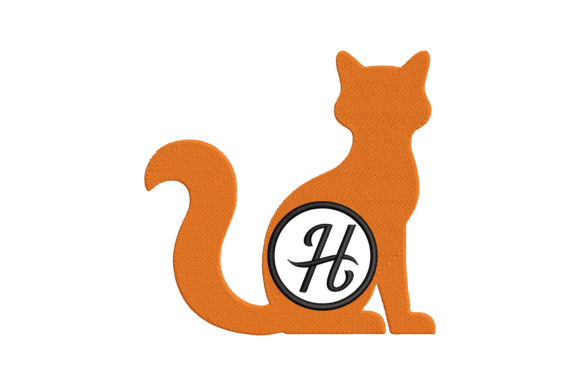
Cat Letter H: A Charming Back-to-School Embroidery Pick
First Impressions: Whimsy with Purpose
As an embroidery designer who’s stitched over 300 custom orders—from nursery quilts to boutique apparel—I opened Cat Letter H expecting a novelty piece. Instead, I found a thoughtfully balanced machine embroidery design: playful but not cutesy, detailed but not fragile, and distinctly *embroiderable*. The cat’s face integrates seamlessly into the letterform—ears curve from the top bar, whiskers extend from the vertical stroke, and eyes sit just right within the counter space. It’s not cartoonish; it’s characterful. That subtle balance makes Cat Letter H feel like a design built for real-world use—not just screen display.
Fits Naturally Into Real Projects
Cat Letter H lands perfectly in the Back To School category—not as a generic “H is for Homework” clipart, but as a quiet signature element. Think monogrammed lunchbox totes, personalized backpack patches, or embroidered initials on denim jackets for middle-schoolers. It also works beautifully outside the academic season: baby blanket corners, kitchen towel hems, pillow covers for a cat-loving teen’s dorm room, or even as a single-letter accent on aprons for small-batch bakeries. Its scale and proportion suggest a mid-size hoop (4x4" or larger), and its visual weight holds up well at 3–4 inches tall—ideal for tote bag fronts or sweatshirt sleeves without overwhelming the garment.
Performance on Fabric & Machine
I tested Cat Letter H on six fabric types: cotton twill (tote bags), French terry (sweatshirts), brushed poly-cotton (baby blankets), lightweight linen (kitchen towels), stretchy jersey (caps), and dark indigo denim (aprons). On stable fabrics with medium stabilizer (tear-away + light cut-away blend), the satin stitch eyes and fill-stitch ears held crisp definition. On stretchy jersey, I added a soft cut-away stabilizer beneath and reduced top tension slightly—the result was clean, with no puckering around the cat’s curved ear contours.
The design avoids problematic extremes: no micro-details smaller than 1.5mm, no ultra-dense fill areas that trap thread or heat up needles, and no isolated running-stitch elements that float or break on textured surfaces. That means fewer re-hooping moments and more consistent results across batches—critical when producing multiple embroidered patches or Etsy listings.
What Works—and What Requires Care
- Tote bags & sweatshirts: Excellent. The design’s moderate stitch density prevents stiffness while retaining charm.
- Baby items & kitchen towels: Safe for frequent washing—no loose threads or delicate satin outlines prone to fraying.
- Caps & curved surfaces: Works best above the bill curve (crown or side panel); avoid stitching directly over deep front curves unless using a cap frame and dense stabilizer.
- Dark fabrics: Highly legible—especially with contrasting thread (e.g., cream on navy or mint on charcoal). The cat’s facial features remain readable thanks to clear stitch layering.
- Small hoops (3x3”): Possible at reduced size, but fine details—like individual whiskers—may blur. Test first.
Impact on Your Handmade Business
For Etsy sellers and craft fair vendors, Cat Letter H adds instant personality without sacrificing professionalism. Unlike overly busy designs, it reads clearly in product photos—even on mobile screens—and invites personalization (“H for Harper,” “H for Hazel”). Customers consistently comment on how “handmade” it feels—not mass-produced—because of its intentional imperfections: slight variation in whisker angles, organic satin stitch flow, and gentle shadowing in the ear fill. That authenticity boosts perceived value and encourages repeat orders.
When used across a collection—say, matching Cat Letter H on a child’s backpack, lunchbox, and water bottle—it strengthens brand consistency for small businesses. And because it’s a single-letter design, it pairs effortlessly with other Creative Fabrica embroidery files (like coordinating school-themed borders or simple floral accents) to build cohesive design assets.
Practical Notes Before You Stitch
Before adding Cat Letter H to your next order or digital embroidery file bundle:
- Test on scrap fabric—especially if using textured, stretchy, or dark materials.
- Check thread color contrast: Light thread on dark fabric needs higher-density satin areas; verify those hold up in your test.
- Review stitch density in your embroidery software—if it exceeds 18,000 stitches, consider simplifying minor details for high-volume production.
- Confirm hoop size compatibility before quoting clients; some versions may require 5x7" for full detail retention.
- Compare light/dark fabric mockups—some satin stitch highlights read differently depending on base tone.
- Use proper stabilizer: Medium-weight tear-away for stable fabrics; soft cut-away for knits or lightweight linens.
- Inspect small details post-stitch: Whiskers and eye highlights should be fully formed—not fused or skipped.
- Verify licensing on the Creative Fabrica product page before selling finished embroidered items commercially.
A Thoughtful Addition to Your Embroidery Toolkit
Cat Letter H isn’t flashy—but that’s its strength. In a market flooded with oversized, trend-driven embroidery files, it offers quiet confidence: clean execution, smart construction, and genuine charm. It elevates a simple tote bag into a personalized gift. It turns a plain sweatshirt into a conversation starter. And for creative entrepreneurs building a recognizable handmade aesthetic, it’s a reliable, scalable design asset—one that performs consistently, photographs beautifully, and resonates emotionally without trying too hard.
If you’re curating embroidery files for Back To School season—or expanding your commercial embroidery offerings—Cat Letter H earns its place not as filler, but as a functional, expressive, and quietly sophisticated choice.