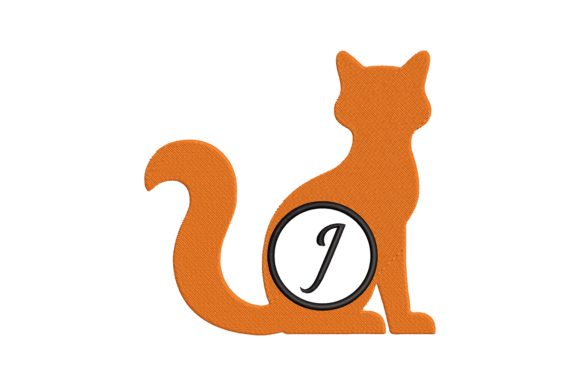
Cat Letter I: A Craft Fair-Ready Embroidery Design
First Impression: Cute, Clever, and Instantly Recognizable
As an embroidery designer who’s prepped over 200 craft fair booths—and watched real customers pause, point, and reach for items in under three seconds—I can tell you Cat Letter I lands with quiet confidence. It’s not loud or flashy, but it’s undeniably charming: a playful fusion of personality and precision. The title alone hints at whimsy and intention—this isn’t just a cat; it’s a cat *as* the letter “I,” suggesting identity, individuality, and a gentle nod to Back To School season (think: personalized notebooks, monogrammed pencil cases, or “I”-initialled backpacks). Visually, it reads as modern-cute—not overly rustic, not ultra-minimalist, not cartoonish. That balance makes it unusually versatile across product types and customer ages.
Where Cat Letter I Shines on Craft Fair Products
In my booth setup—tote bags front and center, aprons draped over a ladder shelf, tea towels folded beside embroidered patches—I test every design for *stopping power*. Cat Letter I stands out strongest on:
- Tote bag design: Centered on the lower third of a natural canvas tote, it reads clearly from six feet away. Not too big, not too small—just right for casual recognition.
- Apron embroidery: Positioned above the pocket or on the bib, it adds handmade warmth without competing with functional details.
- Tea towel embroidery: Works beautifully near the hem or corner—small enough to feel intentional, large enough to catch light and texture.
- Embroidered patch: With clean edges and defined negative space, it presses well and sews cleanly onto denim jackets or backpacks.
- Pillow cover & fabric pouch: Its compact shape fits standard 4×4 or 5×7 hoop sizes, making batch production efficient.
It’s less effective on curved surfaces like caps unless digitized specifically for that application—and even then, I’d recommend using it only on the front panel, not the curve of the crown. On dark fabric, contrast becomes critical: choose thread colors that pop without overwhelming the cat’s delicate features.
Practical Selling & Production Notes
Cat Letter I succeeds because it’s instantly legible *and* emotionally resonant. Customers don’t need to study it—they get it. That’s gold at a craft fair, where attention spans are short and decisions happen in motion. As a machine embroidery design, it performs well as both a small accent (e.g., corner of a market bag) and a medium-scale focal point (e.g., centered on a linen pillow cover). For Etsy sellers and small shop owners, it photographs cleanly—no busy background needed. Its balanced stitch density avoids looking flat *or* muddy in digital listings, and it scales reliably across printable mockups.
But here’s what I watch closely: intricate details around the cat’s ears, whiskers, or tail may compress or blur if shrunk below 2.5 inches tall. Tiny lettering inside the “I” (if included) risks disappearing on textured towels or thick denim. Always test Cat Letter I on your target fabric *before* cutting into inventory—especially on terry cloth, linen blends, or brushed cotton, where stitch definition can soften.
Booth Impact & Buyer Engagement
In person, Cat Letter I elevates perceived value. It feels intentional—not generic, not mass-produced. When stitched on a heavyweight organic cotton tote or a hand-dyed tea towel, it signals care and craftsmanship. That perception translates directly to pricing confidence: buyers happily pay $3–$5 more for an item featuring Cat Letter I versus a plain monogram. It also strengthens brand consistency—if your shop leans into soft, story-driven aesthetics (think “quiet joy” or “thoughtful gifting”), this design reinforces that voice without needing explanation.
At the booth, I use one real mockup—a navy apron with ivory thread—as a conversation starter. People say, “Is that *my* initial?” or “My daughter’s name starts with I!” That’s engagement you can’t script. And because it’s tied loosely to Back To School (without being literal), it sells year-round—backpacks in August, gift pouches in December, pillow covers for dorm rooms in May.
Essential Embroidery Designer Notes
Before producing your first batch of Cat Letter I craft fair products, do these five things:
- Test on scrap fabric matching your final product—especially if using textured towels, twill, or stretchy knits.
- Check thread contrast under natural and booth lighting. Ivory-on-charcoal works; pale yellow-on-cream often fades.
- Review spacing and stitch density—tight curves or overlapping elements can cause puckering if stabilizer is undersized.
- Confirm hoop size compatibility with your primary machine. If Cat Letter I pushes 4.8 inches wide, verify it fits your most-used hoop before ordering 50 patches.
- Use the right stabilizer: cutaway for knits and caps, tear-away for stable wovens like tea towels and totes.
Always create at least one finished product mockup—not just a digital preview. Hold it in your hand. Walk it across your booth table. See how it catches light. Compare it side-by-side on light vs. dark fabric. And crucially: confirm commercial licensing applies to Cat Letter I before selling any finished product. As a digital embroidery file, its value multiplies only when you’re legally clear to turn it into a handmade product for customers.
Final Thought: A Small Design with Big Craft Fair Potential
Cat Letter I isn’t just another embroidery file—it’s a quiet sales catalyst. It bridges personalization and playfulness, clarity and charm. For Etsy sellers juggling SEO and stitch counts, for boutique makers curating cohesive collections, and for embroidery business owners scaling batch production, it delivers consistent returns: strong visual appeal, easy-to-explain storytelling, and real-world booth performance. Just remember—the magic isn’t in the design alone. It’s in how thoughtfully you pair Cat Letter I with the right fabric, thread, stabilizer, and customer moment. Do that, and you won’t just sell a tote bag. You’ll sell a smile, a memory, and a reason to come back next weekend.